
Brighton Collaboration News
Quarterly Updates From Our Vaccine Safety Community, Summer 2026
Partnering to Advance Vaccine Safety Across Africa
A Message from Drs. Andy Stergachis and Hammad Ali
From conference podiums in Ghana to a training workshop in Namibia and collaborative safety evidence generation through active safety surveillance in the Democratic Republic of the Congo, SPEAC members have been working alongside CEPI-partners and others across Africa to advance vaccine safety. Over the past six months, these efforts have brought together scientific exchange, professional training, and real-world evidence generation—all supporting stronger pharmacovigilance systems and vaccine safety preparedness.
Sharing Knowledge
This spring, SPEAC members contributed to two key meetings focused on pharmacovigilance and vaccine safety in Africa. This provided an opportunity not only to share knowledge, but also to strengthen collaborations and identify priorities for current and future work.

At the 5th Annual Conference of Pharmacoepidemiology in Africa in Accra, Ghana, Dale Nordenberg participated in a panel discussion on the role of standardized case definitions in vaccine safety surveillance and evidence generation during public health emergencies. The discussion highlighted the importance of harmonized case definitions in improving the quality and comparability of vaccine safety data across studies and settings.
At the International Society for Pharmacovigilance (ISoP) Africa Chapter Meeting in Windhoek, Namibia, a SPEAC team presented Active Safety Surveillance of Vaccines and Medicines in Africa and Other LMICs: Updated Landscape Assessment (2013–2025) and Interactive Dashboard. Authored by Esperança Sevene, Andy Stergachis, Mohammad Gazi, Rebecca Chandler, Samantha Mudigonda, Dale Nordenberg, and Robert Chen, the work showcased updated findings and practical tools to support active safety surveillance across low- and middle-income countries. The interactive dashboard provides a resource for understanding the current landscape of active safety surveillance and identifying opportunities to expand surveillance capacity that can be accessed here, https://active-surveillance.speacsafety.net/description.

Building Capacity
In partnership with Africa CDC, CEPI, and the Uppsala Monitoring Centre, SPEAC helped develop and deliver training programs on Adverse Events of Special Interest (AESIs) for Vaccine Safety Surveillance in Africa. Co-led by Andy Stergachis, Esperança Sevene, Hammad Ali, and Dale Nordenberg, the 2026 program combined self-paced online learning, weekly webinars, and an intensive in-person workshop in Windhoek, Namibia, held in May 2026. More than 40 pharmacovigilance and immunization professionals from across Africa participated in the in-person component of the training program in Windhoek, expanding regional expertise and building a network of professionals equipped to support future vaccine safety efforts. This training follows an earlier training on AESIs held in Accra, Ghana, last year that was organized by Africa CDC in collaboration with SPEAC and CEPI. Building on the programs’ success, preparations are underway for another Africa CDC-led, CEPI-supported training planned for November 2026. These trainings aim to strengthen Africa’s capacity to detect, classify and respond to AESIs for vaccines targeting high-threat pathogens, including Mpox, Lassa Fever, Chikungunya, and emerging Disease X viruses.
SPEAC also continued to build clinical trial safety expertise through its largest Data and Safety Monitoring Board (DSMB) Training Program to date. Delivered in collaboration with Africa CDC, the program brought together participants from across the continent—including clinicians, epidemiologists, statisticians, pharmacovigilance specialists, and other public health professionals—to develop expertise in independent clinical trial safety oversight.
Generating Evidence
Andy Stergachis and Esperança Sevene supported the design and implementation of a CEPI-funded cohort event monitoring study in the Democratic Republic of the Congo evaluating the post-marketing safety of Mpox vaccines. The study generated real-world safety data to support vaccine safety monitoring and evidence-based public health decision-making during the Mpox public health emergency.
Together, these activities illustrate SPEAC’s commitment to working alongside partners across Africa to advance vaccine safety through scientific collaboration, capacity building, and evidence generation.
Community Updates
SCIENCE BOARD UPDATES
The Brighton Collaboration Science Board met virtually in January, April, and July to review strategic priorities amid shifting global and U.S. public health landscapes. Key topics included:
- Exploring ways to connect Brighton audiences with the Safety Platform for Emergency vACcines (SPEAC) Educational Resource Library and drafting one-pager style communications for potential funders.
- Reviewing how standardized case definitions affect vaccine-study interpretation and exploring field testing, regulatory alignment and artificial intelligence.
- Supporting an application to join the World Health Organization (WHO) Coalition of Interested Parties (CIP).
- Planning annual Board elections, with an emphasis on broader expertise and geographic representation.
Brighton Collaboration has added its Constitution and Regulations to the website, making these foundational governance documents more accessible to members and partners.
CASE DEFINITIONS & TECHNICAL RESOURCES
New Case Definition for Acute Intraocular Inflammation
Brighton Collaboration has published a new case definition for acute intraocular inflammation, providing standardized criteria for consistent assessment across vaccine-safety settings.
The definition covers anterior, intermediate, and posterior uveitis; panuveitis; retinal vasculitis; and neuroretinitis. It is intended for clinical trials, background-incidence studies, causality-assessment studies, and post-licensure pharmacovigilance.
The complete definition is published in Vaccine. These resources were developed through the CEPI-funded SPEAC project.
Additional Levels of Diagnostic Certainty Resources
Two additional LOC charts are now available:
- Acute multi-organ dysfunction: Developed through a working group with expertise in intensive care, sepsis, and hematology. The chart provides proposed criteria for classifying potential cases while development of the full case definition continues.
- Fetal vaccinia: A revised chart provides a standardized framework for assessing and classifying cases.
Access the resources:
World Health Organization Resource References Brighton Standards
A recent WHO publication references Brighton Collaboration within the broader ecosystem of internationally recognized vaccine-safety tools and methods.
The resource highlights the value of standardized approaches to adverse-event assessment, data interpretation, and evidence generation across studies, surveillance systems, and geographic regions.
Watch the Automated Brighton Classification Tool Webinar
The recording of the first webinar in SPEAC’s free webinar series is now available.
The session introduces the Automated Brighton Classification (ABC) Tool, which guides users through structured questionnaires based on Brighton Collaboration case definitions and automatically determines the appropriate Level of Diagnostic Certainty. A live demonstration shows how the tool can support consistent case classification across clinical, research and surveillance settings.
The webinar, attended by more than 230 participants, also features perspectives from Clare Cutland, Florence van Hunsel, Emmanuel Masunga, Walter Strauss and Biniyam Tedla on potential applications of the tool in different vaccine-safety contexts.
EBOLA VACCINE SAFETY RESOURCES
New Ebola Adverse Events of Special Interest Lists
SPEAC has released new Ebola AESI lists, including tailored considerations for ChAdOx1, rVSV and mRNA platforms.
Dashboard Maps the Ebola Vaccine Evidence Landscape
A complementary Living Systematic Review (LSR) dashboard provides an interactive overview of available Ebola vaccine evidence, including evidence involving pregnant people, children, and adolescents.
The review team screened 3,515 records, assessed 779 full-text articles, included 297 studies, and characterized 88 clinical studies in detail.
Analysis of vaccine efficacy, effectiveness, safety, and immunogenicity outcomes was still underway when the dashboard launched. The current resource should therefore be understood as an evidence map rather than a completed assessment of those outcomes.
Together, the AESI lists and dashboard support different aspects of preparedness: the lists inform prospective safety planning, while the dashboard maps the existing evidence landscape.
Explore the Ebola Vaccines Living Systematic Review Dashboard
Brighton GAIA Preterm Birth AESI
A new educational video provides an overview of the Brighton Collaboration Global Alignment of Immunization Safety Assessment in Pregnancy (GAIA) case definition for preterm birth.
The video covers:
- Definition and classification of preterm birth
- Background rates and clinical risk factors
- Gestational-age assessment
- Levels of diagnostic certainty
- Standardized data collection and reporting
Interactive Dashboards Bring Brighton Standards Into Digital Practice
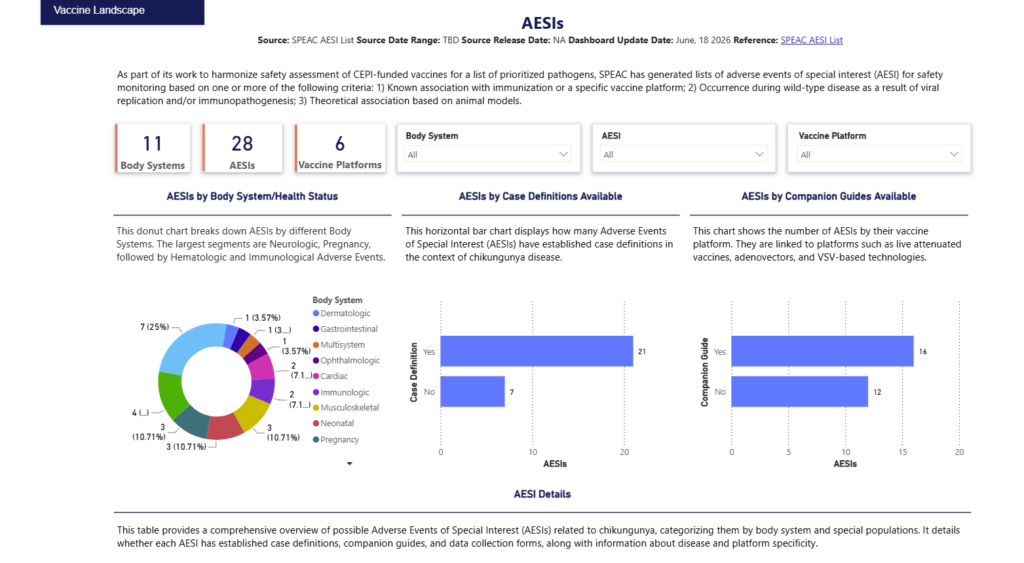
The CEPI Vaccine Safety Intelligence (CVSI)
platform includes interactive AESI dashboards based on Brighton case definitions and companion guides. Users can explore diagnostic criteria, levels of certainty, published evidence, and related terminology.
Dashboards currently available include:
- GBS
- Generalized convulsive seizures
- thrombocytopenia
🔗 Explore the dashboard: https://active-surveillance.speacsafety.net/description
Publications
New Publication Reviews Seven Years of SPEAC
A new article in Vaccine Insights reviews the development and contributions of SPEAC from 2019 through 2026. The article covers AESI lists, Brighton case definitions and companion guides, vaccine-safety templates, living systematic reviews, resources for special populations, DSMB support, and digital tools.
Updated Analysis Supports Nipah Vaccine-Safety Planning
SPEAC has published an updated landscape analysis and priority list of AESIs for Nipah virus vaccines.
The report reviews evidence published since the original 2020 analysis and updates recommendations supporting standardized safety assessment in future Nipah vaccine clinical trials. It also incorporates additional vaccine platform-associated events relevant to current vaccine candidates.
Read the updated landscape analysis
Applying Brighton Case Definitions to Real World Data
A new publication from the Vaccine Monitoring Collaboration for Europe (VAC4EU) describes a structured approach for applying Brighton Collaboration case definitions to heterogeneous real-world data.
The pipeline combines expert review of case definitions, standardized electronic data-collection forms, test cases, decision logic, and abstractor training. It was applied to 16 COVID-19 vaccine-safety outcomes, 13 of which had existing Brighton definitions.
The work illustrates how Brighton standards can be adapted and operationalized to improve consistency in post-authorization vaccine-safety studies.
Read Harmonizing Case Validation for Vaccine Safety in Real-World Data: The VAC4EU Experience
Brighton Standards in Practice
Two additional studies examined the use of Brighton standards and related coding strategies in real-world vaccine-safety data:
- Validation of Guillain-Barré syndrome case identification: Researchers assessed case identification across three heterogeneous VAC4EU data sources in Spain using Brighton Collaboration criteria and levels of diagnostic certainty. Read the publication
- Accuracy of clinical coding strategies: Researchers evaluated International Classification of Diseases and Systematized Nomenclature of Medicine search strategies for identifying adverse events of special interest in Aotearoa New Zealand. Read the publication
Together, these studies illustrate both the value and practical challenges of applying standardized case definitions across different health-data systems.
Global Scientific Engagement
Advancing Vaccine-Safety Preparedness at ISPE AfRIG 2026
Safety Platform for Emergency vACcines (SPEAC) and Brighton Collaboration representatives participated in the 5th Annual Conference on Pharmacoepidemiology in Africa in Accra, Ghana.
In a presentation delivered by Rebecca Chandler of the Coalition for Epidemic Preparedness Innovations (CEPI), attendees learned about the progress of the Adverse Events of Special Interest–X (AESI-X) working group led by Brighton Collaboration’s Eileen Farnon and Robert Chen.
The presentation highlighted the AESI-X Case Definition Preparedness Plan, designed to support rapid, consensus-based development of standardized case definitions for novel or previously undefined vaccine safety events.
The conference also included a symposium on the role of case definitions in preparedness and evidence generation during public health emergencies, featuring SPEAC Digital Transformation Lead Dale Nordenberg and regional experts Edinam Agbenu and Nana Ansah.
World Vaccine Congress
At the 2026 World Vaccine Congress in Washington, D.C., SPEAC experts presented two sessions focused on strengthening how vaccine safety data are defined and used, building on the work of Brighton Collaboration:
- The Value of Brighton Collaboration Case Definitions in Observational Data examined evidence supporting the use of Brighton case definitions in post-licensure surveillance and their role in improving the consistency, comparability, and interpretation of vaccine safety data.
- Achieving Synergy Between Brighton Collaboration Case Definitions and MedDRA Terminology explored approaches to better align Brighton case definitions with the Medical Dictionary for Regulatory Activities (MedDRA) to improve data interoperability, signal detection, and the usability of vaccine safety data.
European Society for Paediatric Infectious Diseases
The SPEAC Special Populations Work Package presented four posters at the European Society for Paediatric Infectious Diseases (ESPID) annual meeting.
The posters addressed:
- Vaccine trials involving pregnant and lactating women
- Development of the fetal vaccinia case definition
- Evidence concerning Brighton GAIA maternal-immunization definitions
- Maternal COVID-19 vaccination and infant outcomes
Learn more about SPEAC Special Populations research at ESPID 2026
Governance Updates
CEPI Appoints Incoming Chief Executive Officer
The CEPI Board has appointed Professor Ibrahim Abubakar as its next Chief Executive Officer.
Professor Abubakar will join CEPI in March 2027 and assume the role in April 2027. Founding Chief Executive Officer Dr. Richard Hatchett will remain in post through April 2027 to support the transition. As a key Brighton Collaboration and SPEAC partner, CEPI supports work to strengthen vaccine-safety tools and preparedness for epidemic and pandemic threats.
STAY CONNECTED
Brighton Collaboration welcomes participation from vaccine-safety researchers, clinicians, regulators, public-health professionals, and other contributors worldwide. Members receive updates on new case definitions, resources, working groups, and opportunities to participate.